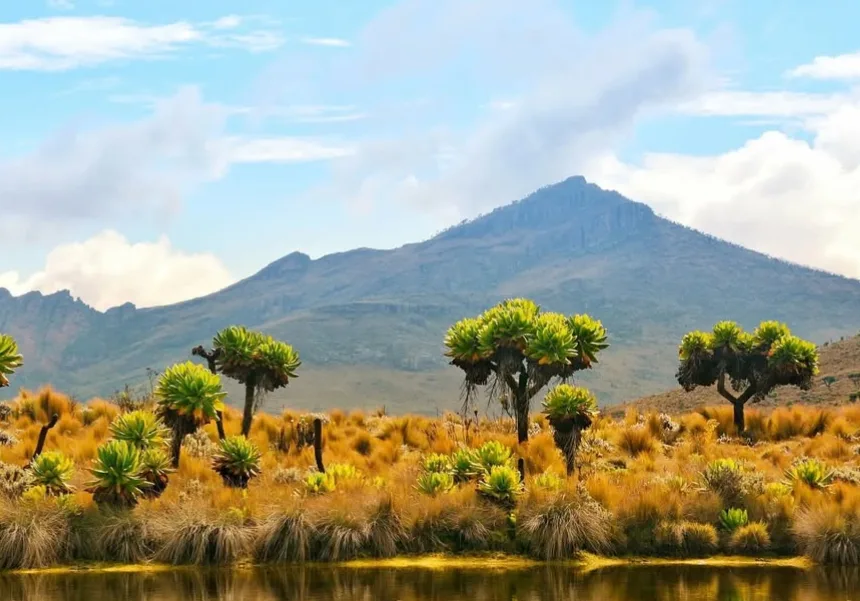
Mount Elgon National Park is a National Park in Trans-Nzoia and Bungoma Counties, Kenya. The park is renowned for its vast underground caves, including the salt-mining elephants of Kitum Cave, diverse montane forests, and the dramatic cliffs of Endebess Bluff.
Overview
Name
Mount Elgon National Park
Type
Mountain
Town
Kitale
Country
Kenya
Key Facts & Administrative Data of Mt. Elgon National Park
Attribute Category
Specific Detail
Location Coordinates
Approximately 1.1200° N, 34.5600° E
Governance/Management
Kenya Wildlife Service (KWS)
Total Area
169 square kilometres (Kenyan side)
Entry Fees
Tiered pricing for Citizens, Residents, and Non-Residents. Fees are subject to change; refer to official KWS tariffs.
Primary Attraction
Extinct shield volcano, vast cave systems (e.g., Kitum Cave), salt-mining elephants, and unique montane flora.
Best Time to Visit
During the dry seasons: June to August and December to March.
Volcanic Origins and Caldera
Mount Elgon stands as the oldest extinct shield volcano in East Africa, predating the formation of the Rift Valley. Unlike the steep, conical structures of the Virunga Mountains, Elgon presents a massive, gradual base exceeding 80 kilometres in diameter.
The geological focal point is the caldera, which spans approximately 8 kilometres, making it one of the largest intact calderas globally.
The volcano's geological distinctiveness lies in its subterranean landscape. Pyroclastic deposits have eroded over millennia to form an extensive network of lava tube caves. Notable formations include:
Kitum Cave: Extending 200 metres into the mountainside, famous for its salt-rich walls.
Mackingeny Cave: Located near the Sipi Falls area, characterised by crystalline wall formations.
Chepnyalil Cave: A smaller formation often used by smaller mammals for shelter.
Ngwarisha Cave: Located near the community forest boundary.
Comparative Analysis: Unlike Mount Kilimanjaro, where volcanic activity is dormant but geologically recent, Elgon's ancient status has allowed for deeper soil formation and more complex cave erosion, creating habitats absent in younger volcanic parks.
Flora and Fauna Biodiversity
The vegetation on Mount Elgon follows a strict altitudinal zonation, offering a clear transect of East African montane ecology.
The park transitions from wet montane forest to high-altitude moorland. Uniquely, the park contains pockets of Podocarpus gracilior forest, a remnant of a once broader distribution.
Key botanical zones include:
Montane Forest (2,000m – 2,500m): Dominated by Olea welwitschii (Elgon Olive) and Prunus africana.
Bamboo Zone (2,500m – 3,000m): Dense stands of Yushania alpina (African Alpine Bamboo).
Heath and Moorland (3,000m – 3,500m): Characterised by Giant Heather (Erica arborea) and tussock grasses.
Afro-Alpine Zone (Above 3,500m): Home to endemic giant groundsels (Dendrosenecio elgonensis) and Giant Lobelias (Lobelia deckenii and Lobelia telekii).
Bird Watching at Mt. Elgon Kenya
Mount Elgon National Park supports over 300 avian species, including several restricted-range species endemic to the Afrotropical Highlands biome. The park offers an important habitat for raptors due to the thermal updrafts generated by the caldera walls.
Significant sightings for ornithologists include:
Lammergeier (Gypaetus barbatus): An endangered bearded vulture often sighted soaring over the caldera.
Jackson's Francolin (Pternistis jacksoni): Restricted to high-altitude montane forests.
Tacazze Sunbird (Nectarinia tacazze): A high-altitude nectar feeder found in the heath zone.
Black-collared Apalis (Oreolais pulcher): Common in the lower canopy of the mixed forest.
Gap Analysis: While Queen Elizabeth National Park boasts higher total species counts due to savanna habitats, Mount Elgon offers specific montane endemics that are absent in low-altitude Ugandan parks.
Mammalian Wildlife Encounters
The mammalian biomass in Mount Elgon is lower than in savanna parks, but the behaviour and speciation are distinct.
The park is renowned for its population of "salt-mining" elephants. These African Savanna Elephants (Loxodonta africana) have adapted to the mineral-deficient montane environment by entering caves like Kitum to gouge sodium-rich rocks from the walls using their tusks.
Other resident mammals include:
Black-and-white Colobus (Colobus guereza): Found in the canopy of the montane forest.
De Brazza’s Monkey (Cercopithecus neglectus): A shy, swamp-dwelling primate often found near the Suam River.
Leopard (Panthera pardus): The apex predator of the park, though elusive and primarily nocturnal.
Bushbuck (Tragelaphus scriptus): Frequently grazed on the forest margins.
Oremys (Elgon Shrew): A small mammal endemic to this specific mountain range.
Hiking and Mountain Climbing Opportunities
Mount Elgon offers a mountaineering experience that requires no technical equipment, differing significantly from the Rwenzori Mountains which necessitate crampons and ropes. The terrain allows for trekking rather than technical climbing, making it accessible to hikers with moderate fitness levels.
The primary trailheads are:
The Sasa Trail: The most direct route to the summit, starting from Budadiri. It involves a steep ascent through the "Wall of Death" (local name for steep cliffs) and bamboo forests.
The Piswa Trail: A gentler, longer route starting from Kapkwata. This trail is preferred for wildlife viewing as it passes through the Podocarpus forest.
The Sipi Trail: Starts near the Sipi Falls and joins the Piswa trail, offering a longer, multi-day trekking option.
Major Peaks of Mount Elgon
The mountain features a jagged rim surrounding the caldera, with several distinct peaks marking the high points of the shield volcano. Hikers typically aim to summit the highest point, but the ridge offers multiple destinations.
Wagagai Peak (4,321 metres): The highest point, located entirely within Uganda.
Sudek (4,302 metres): Located on the Kenya-Uganda border.
Koitobos (4,222 metres): A flat-topped basalt column located on the Kenyan side.
Mubiyi (4,211 metres): A significant peak on the Ugandan rim.
Masaba (4,161 metres): Named after the ancestral father of the Bagisu people.
Local Communities and Cultural Experiences
The slopes of Mount Elgon are densely populated by the Bagisu (BaMasaba) and the Sabiny people. Agriculture, specifically Arabica coffee cultivation, dominates the lower slopes.
The cultural landscape is defined by the Imbalu ceremony, a biennial circumcision ritual practised by the Bagisu, marking the initiation of boys into manhood.
Visitors can engage with these communities through:
Coffee Tours: Tracking the process of organic Arabica coffee from farm to cup in the Sipi region.
Cultural Centres: The Budadiri community offers guided walks focusing on cultural heritage and agricultural practices.
Essential Travel Information for Mount Elgon National Park
Planning a trip to Mount Elgon requires careful preparation. This guide provides information on park fees, transport options from Nairobi, and an overview of accommodation. This helps visitors organise their trip efficiently.
1. Mount Elgon National Park Entry Fees & Costs
Entry fees for all national parks in Kenya are managed by the Kenya Wildlife Service (KWS) and are structured based on your residency status and age. Fees are typically valid for a 24-hour period. Visitors must confirm the most current rates on the official KWS website before travelling. Rates are subject to change.
Payment is strictly cashless. You can pay at the gate using M-Pesa (a mobile money service), or by debit/credit card.
Park Entrance Fee Structure
The pricing is tiered to differentiate between international visitors (Non-Residents), residents of East African countries (Kenya, Tanzania, Uganda, Rwanda, Burundi, South Sudan), and Kenyan Citizens.
Category
Park Entry Fee (Per Person, Per 24 Hours)
Notes
Non-Resident Adult
USD $35 - $50 (Typical Range)
Paid in USD or the KES equivalent.
Non-Resident Child/Student*
USD $20 - $25 (Typical Range)
*Child rates apply from 3 to 17 years. Students require a valid student ID.
East African Resident Adult
KES 500 - 1,000 (Typical Range)
Proof of residency (e.g., work permit, alien card) is required.
East African Resident Child/Student*
KES 250 - 500 (Typical Range)
Proof of residency and student status required.
Kenyan Citizen Adult
KES 400 - 600 (Typical Range)
A valid National ID or Passport is required.
Kenyan Citizen Child/Student*
KES 200 - 300 (Typical Range)
Proof of citizenship and student status required.
Disclaimer: The prices listed above are indicative and for planning purposes only. Please verify the exact current fees on the KWS e-Citizen portal before travelling.
Other Potential Costs
Vehicle Entry Fee: A daily fee is charged per vehicle, depending on its size (e.g., under 6 seats, 6-12 seats).
Camping Fees: If you plan to camp at a public or special campsite, a nightly fee per person applies.
Activity Fees: Special activities like guided hikes, porter services, and guide fees are separate costs paid directly to the service providers or through your tour operator. A KWS Ranger/Guide is mandatory for any trekking on the mountain.
2. Logistics of Getting to Mount Elgon
The primary gateway to Mount Elgon National Park is the town of Kitale. Most journeys begin from Nairobi, Kenya's capital city.
By Road from Nairobi
Route: The most direct route follows the A104 Highway from Nairobi north-west towards Nakuru and Eldoret. From Eldoret, you continue to Kitale. The park's main gate, Chorlim Gate, is approximately 35-40 km from Kitale town.
Distance: Approximately 420 kilometres (260 miles).
Travel Time: Expect the drive to take between 7 to 9 hours, depending heavily on traffic conditions when leaving Nairobi and the number of stops you make.
Vehicle Recommendation: Whilst the main highways are tarmacked and in good condition, the final stretch to the park gate and the roads within the park are unpaved. A 4x4 vehicle is highly recommended, especially during the rainy seasons (April-June and October-November), when tracks can become muddy and challenging.
By Air
Route: For a faster and more comfortable journey, you can fly from Wilson Airport (WIL) in Nairobi to the Kitale Airstrip (KTL).
Airlines: Scheduled services are operated by airlines such as Safarilink. The flight typically takes around 60-75 minutes.
Onward Travel: From Kitale Airstrip, you will need to arrange a pre-booked road transfer to your accommodation or directly to the park gate. This final road leg takes approximately 1 to 1.5 hours. This is a convenient option that saves a full day of driving.
3. Accommodation Strategy and Where to Stay
Accommodation choices influence a Mount Elgon experience. Visitors decide whether to stay inside the park for an immersive experience or outside for more variety and access to town amenities.
Inside Mount Elgon National Park
Staying within the park offers a close connection to nature. Visitors hear forest sounds and have immediate access to hiking trails at dawn.
KWS Self-Catering Guesthouses: KWS manages a few rustic guesthouses, such as the Koitoboss Guesthouse. These offer basic but comfortable facilities where you bring and prepare your own food. They are ideal for groups and those seeking an authentic, secluded experience. Booking well in advance is recommended.
Public & Special Campsites: For the adventurous, the park offers several campsites. You must be entirely self-sufficient, bringing all your own camping gear, food, and water. This is the most budget-friendly and immersive way to experience the park's wilderness.
Best for: Enthusiastic hikers, birdwatchers, and visitors who want to start mountain treks early, without travel time.
Outside the Park (in Kitale and its Surrounds)
Staying in the nearby town of Kitale or in lodges on its outskirts provides more flexibility, a wider range of comfort levels, and easier logistics for supplies.
Hotels and Lodges in Kitale: Kitale offers a variety of accommodation, from mid-range hotels with full services (restaurants, Wi-Fi) to more modest guesthouses. This is a practical option if you need to stock up on supplies or prefer hotel comforts.
Farm Stays & Country Lodges: The agricultural highlands around Kitale are home to several charming farm stays and lodges. These often provide a more personal experience than a town hotel, with gardens and farm-to-table meals. They are still within a reasonable driving distance of the park gate.
Best for: Visitors on a multi-destination trip, those who prefer hotel amenities, families, and travellers seeking a broader range of dining and budget options.
Mount Elgon National Park weather
Mount Elgon offers optimal trekking and photography conditions during its two drier seasons: January to February and late June to early September. These periods generally feature less rainfall, clearer skies, and better visibility, although afternoon showers and mists can still occur, especially at higher elevations.