If you have a Kenya safari booked or are considering travelling from the UK, news of a confirmed Kenya Ebola outbreak case may understandably make you question whether you should still go.
The most important point is to distinguish between an imported Ebola case in Kenya and a nationwide Ebola outbreak. On 6 October 2026, Kenya's Ministry of Health confirmed the country's first imported case of Bundibugyo virus disease in a Kenyan citizen who had been living in the Democratic Republic of the Congo (DRC). The individual travelled from the DRC through Uganda before arriving in Nairobi and was isolated after arrival. The patient subsequently died.
For UK travellers, the situation is being monitored closely, but the UK government's current assessment does not describe the risk to the UK population as high. UKHSA currently assesses the risk of the Ebola outbreak to the UK population as low.
However, this does not mean you should ignore the situation. If you are travelling to Kenya for a safari, particularly through Nairobi or as part of a multi-country East African itinerary, you should check the latest official advice before departure and understand what the current screening and health precautions mean for your trip.
Is it safe for UK travellers to go on safari in Kenya right now?

There is currently no blanket UK government instruction telling travellers not to visit Kenya because of Ebola.
The FCDO's Kenya travel advice states that Kenya's Ministry of Health confirmed its first imported Ebola case on 6 October 2026 and that Kenyan authorities are responding with contact tracing, surveillance, border screening and quarantine arrangements for people considered at risk. The FCDO advises travellers to follow local authorities' instructions and monitor updates from the Kenyan Ministry of Health.
The FCDO also has separate regional warnings for parts of Kenya for reasons unrelated to Ebola. These warnings apply to specific areas and should be checked against your actual safari itinerary rather than interpreted as a warning against travelling to the whole country.
For someone travelling on a conventional Kenya safari itinerary, the practical question is therefore not simply "Does Kenya have Ebola?" It is:
Where are you travelling, how are you entering Kenya, are you transiting through another affected country, and what does the latest official health advice say immediately before departure?
That distinction is particularly important for UK travellers whose itinerary may include Nairobi followed by the Masai Mara, Amboseli, Samburu, Tsavo or the Kenyan coast.
What happened with the Kenya Ebola case?
Kenya's Ministry of Health confirmed the imported Bundibugyo Ebola case on 6 October 2026.
According to the Kenyan government, the patient was a Kenyan citizen who had been living in the DRC. He travelled by road to Kampala before boarding Jambojet flight 8523 to Nairobi on 3 October. After arriving at Jomo Kenyatta International Airport, he was taken to Nairobi Hospital, where he was isolated and assessed.
The case was subsequently confirmed as Bundibugyo virus disease.
Kenya's Ministry of Health has since activated contact tracing and strengthened surveillance. On 7 October, the Ministry reported that 57 contacts had been identified, with 10 people accounted for and placed under quarantine while efforts continued to trace the remaining contacts.
The Kenyan government has also strengthened preparedness at points of entry and increased screening at JKIA, particularly for passengers arriving from countries associated with the current Ebola situation.
Does Kenya currently have an Ebola outbreak?
This is one of the most important distinctions for travellers.
Kenya has confirmed an imported case, but the Kenyan Ministry of Health has stated that the country is not experiencing an Ebola outbreak. At the same time, health authorities are actively conducting contact tracing and surveillance because an imported case can potentially lead to further transmission if contacts are infected.
The wider regional Ebola situation is different.
The current Bundibugyo virus outbreak is centred primarily in the Democratic Republic of the Congo. UKHSA reports sustained community transmission in the DRC, while Uganda's 2026 Bundibugyo outbreak was declared over in August after no new locally acquired cases were detected for the required monitoring period.
This is why UK travellers should pay particular attention to their route into and out of Kenya, rather than assuming that every safari destination in the country carries the same level of risk.
What does the FCDO currently say about Kenya?
The FCDO's current Kenya health advice confirms the imported Ebola case and says Kenya is implementing:
- contact tracing
- disease surveillance
- border screening
- quarantine arrangements for people considered at risk
The FCDO also warns that some countries may introduce additional health screening requirements for travellers arriving from Kenya. If your journey includes another country after Kenya, you should check that country's current entry and transit requirements as well as your airline's instructions.
This matters particularly if your safari is part of a wider itinerary involving another East African country or if you have a connecting flight outside Kenya.
What does this mean if your safari starts in Nairobi?
For many UK visitors, Nairobi is the first point of contact with Kenya.
The current Ebola response means that health screening and surveillance measures may affect your arrival process. Kenyan authorities have intensified screening at JKIA, particularly for travellers arriving from specified countries in the region.
If you are flying directly from the UK to Nairobi, your circumstances may therefore differ from those of a traveller arriving in Kenya after spending time in the DRC or another country subject to enhanced screening.
The safest approach is to:
- Check the FCDO Kenya travel advice before leaving the UK.
- Check the Kenyan Ministry of Health's latest announcement.
- Check your airline's current travel requirements.
- Confirm whether any country on your itinerary has introduced additional screening or entry requirements for travellers coming from Kenya.
- Allow additional time at the airport if screening measures are in operation.
Health screening requirements can change quickly during an infectious-disease event.
What if I am flying directly from the UK to Kenya?
A direct UK-to-Kenya itinerary is different from an itinerary that includes travel through an Ebola-affected area.
The current FCDO guidance specifically highlights enhanced screening for people arriving in Kenya from certain countries and warns that other countries may introduce additional screening requirements for travellers arriving from Kenya.
Therefore, if your itinerary is simply:
UK → Nairobi → Kenya safari → Nairobi → UK
you should monitor the official advice but should not assume that the existence of an imported case automatically means your safari has been cancelled or that you are prohibited from entering Kenya.
Your actual circumstances can change if you have recently travelled through an affected country.
What if my safari includes Uganda or another East African country?
This is an important consideration for travellers planning a multi-country holiday.
The current Ebola situation originated in the DRC, and countries in the region have introduced enhanced surveillance and screening measures at different times.
Uganda's 2026 Bundibugyo Ebola outbreak was declared over in August, but UKHSA continues to monitor the wider regional situation.
If your holiday combines Kenya with Uganda, Tanzania, Rwanda, the DRC or another country in the region, do not rely on advice for Kenya alone.
Check the requirements for every country you will enter or transit through, including requirements that may apply because of where you have travelled previously.
Are the Masai Mara and other safari destinations affected?
The confirmed Kenyan case was imported into Nairobi after the traveller arrived from Uganda, and the patient was isolated in Nairobi.
There is therefore an important difference between saying "Kenya has confirmed an imported Ebola case" and saying "Kenya's safari parks are experiencing an Ebola outbreak."
The official sources reviewed for this article do not report confirmed Ebola transmission in the Masai Mara, Amboseli, Samburu or Tsavo.
However, absence of a reported case in a safari destination should not be presented as a permanent guarantee of safety. Disease surveillance is continuing and the situation can change.
If you are already booked for a safari, the most reliable approach is to check the FCDO and Kenyan Ministry of Health advice shortly before travelling rather than relying on an older article or social-media post.
How does Ebola spread?
Understanding transmission can help put the current situation into context.
According to the UK's TravelHealthPro, Ebola is spread through close, direct contact with infected body fluids, including blood, faeces, saliva, urine, vomit and other bodily fluids. People infected with Ebola can transmit the virus when they have symptoms.
This is different from respiratory viruses that can spread easily through ordinary casual contact.
For safari travellers, sensible precautions therefore include:
- Avoid close contact with anyone who is visibly unwell.
- Do not touch blood or other bodily fluids.
- Do not handle items contaminated with bodily fluids.
- Avoid contact with wild animals, particularly bats and non-human primates.
- Do not eat, prepare or handle raw or unknown-source wild meat.
- Wash your hands regularly with soap and water or use alcohol-based hand sanitiser.
- Follow local health instructions if you are asked to undergo screening or monitoring.
These measures are particularly relevant when travelling through airports, hotels, restaurants and other places where you may have closer contact with other people.
What symptoms should UK safari travellers know?
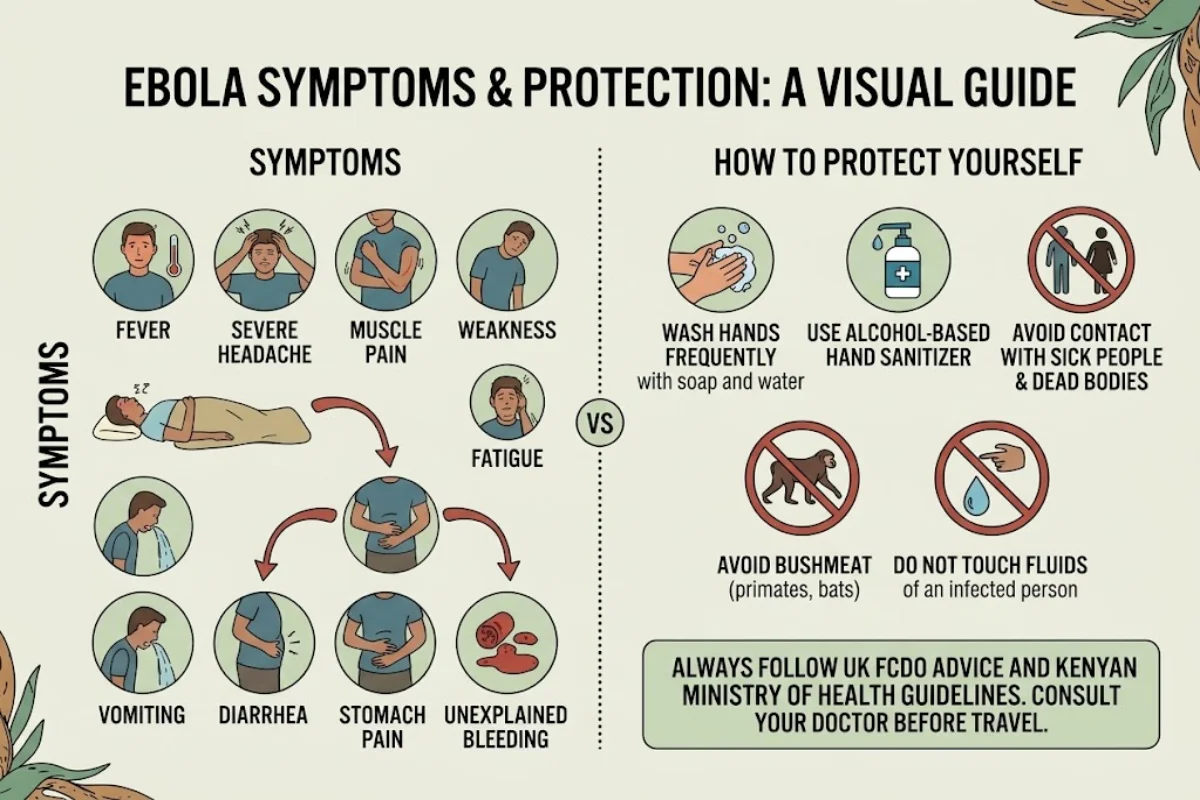
Ebola can cause a serious illness, with symptoms typically beginning suddenly.
TravelHealthPro lists symptoms including:
- fever
- headache
- weakness
- joint and muscle pain
- sore throat
- vomiting and diarrhoea
- and, in severe disease, internal or external bleeding.
If you become unwell while in Kenya, seek medical advice promptly and tell healthcare staff about your recent travel history.
If you become unwell after returning to the UK, TravelHealthPro advises contacting your GP or NHS 111 and telling them about your recent travel. It also stresses that Ebola is an extremely unlikely explanation for fever in a returning traveller, while illnesses such as malaria can be important causes of fever after travel to Kenya.
Should I cancel my Kenya safari because of Ebola?
Do not make the decision based solely on social-media reports or headlines.
Instead, consider four things:
1. The latest FCDO advice
The FCDO is the most important government source for UK travellers. Its Kenya health advice currently confirms the imported Ebola case and the Kenyan response measures.
2. Your exact itinerary
A direct Kenya safari itinerary is different from a trip that includes the DRC or other countries affected by the Ebola situation.
3. Your travel insurance
The FCDO recommends appropriate travel insurance that covers local medical treatment and unexpected medical evacuation. TravelHealthPro also advises travellers to discuss their plans with their insurance provider because travel to an Ebola-affected area may affect available cover.
4. Changes between booking and departure
An infectious-disease situation can change quickly.
If your safari is several weeks or months away, today's situation should not be treated as a guarantee of what conditions will be like on your departure date.
What should I do before travelling from the UK?
For a Kenya safari during the current Ebola situation, a sensible pre-departure checklist is:
Check the FCDO advice: Review the Kenya page shortly before departure and again if there are significant developments.
Check Kenya's Ministry of Health: Look for the latest official information about Ebola surveillance, screening and any changes at points of entry.
Check TravelHealthPro: Review the latest UK travel-health recommendations for Kenya.
Check your insurance: Confirm that your policy remains valid for your itinerary and provides appropriate medical treatment and evacuation cover.
Check your airline: Screening and transit requirements can change with limited notice.
Review your complete itinerary: If you are travelling through Uganda, Tanzania, Rwanda, the DRC or another country before or after Kenya, check the rules for each country.
Allow extra airport time: Enhanced health screening may take longer than normal immigration processing.
What happens if I am asked to complete health screening in Kenya?
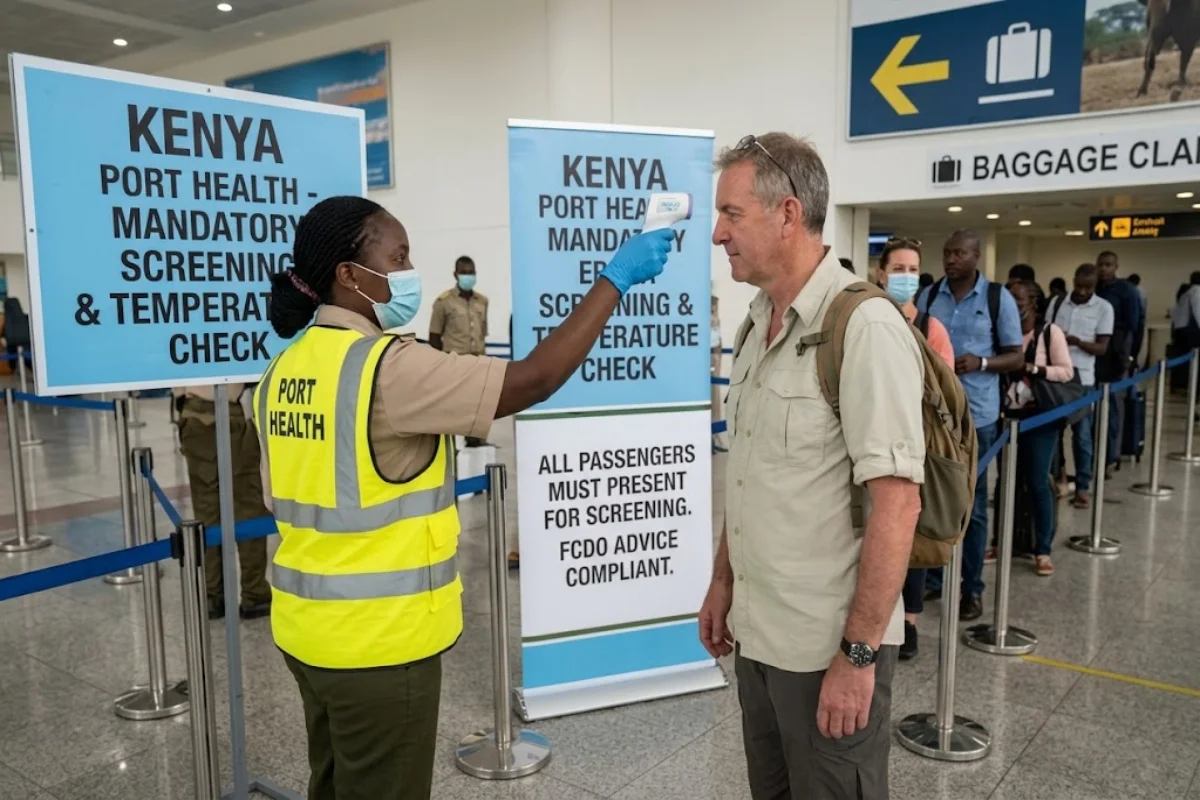
Follow the instructions of Kenyan health officials.
The Ministry of Health has strengthened screening at points of entry and has specifically called on travellers to complete health declaration forms truthfully and provide accurate information to support surveillance and contact tracing.
If screening is required, it does not automatically mean that you have Ebola or that your safari must be cancelled. Screening is a public-health measure intended to identify people who may require further assessment.
What about returning to the UK after my safari?
The UK government is monitoring the situation, and UKHSA currently assesses the risk from the wider Ebola outbreak to the UK population as low.
If you develop symptoms after returning to Britain, do not simply assume that you have a normal post-travel illness. Contact your GP or NHS 111, explain that you have recently travelled to Kenya, and follow the medical advice you receive.
For the latest requirements, always check current UK government guidance rather than relying on an article published before your trip.
What could change the situation for Kenya safari travellers?
The advice could change if there is evidence of further transmission in Kenya, particularly sustained community transmission, or if the Kenyan government, FCDO, UKHSA, WHO, airlines or transit countries introduce new measures.
This is why an article about an active infectious-disease situation should be treated as a snapshot, not a permanent declaration that Kenya is either safe or unsafe.
For a safari departure in the coming days, check the official sources immediately before travelling.
Frequently Asked Questions
Is Kenya currently experiencing an Ebola outbreak?
Kenya has confirmed an imported case of Bundibugyo virus disease. The Kenyan Ministry of Health has stated that the country is not experiencing an Ebola outbreak, while health authorities continue contact tracing, surveillance and screening.
Can UK travellers still go on safari in Kenya?
There is no blanket FCDO instruction against travelling to Kenya because of Ebola. However, the FCDO has specific regional travel warnings within Kenya for other security reasons, and travellers should check their exact safari route before departure.
Is the Masai Mara affected by Ebola?
The official sources reviewed for this update do not report a confirmed Ebola case in the Masai Mara. The confirmed Kenyan case was an imported case involving a traveller who arrived in Nairobi from Uganda after travelling from the DRC.
Does Ebola spread through casual contact?
Ebola is primarily transmitted through close, direct contact with the body fluids of an infected person. TravelHealthPro advises avoiding contact with symptomatic people, bodily fluids and potentially contaminated materials.
What if I am travelling through another African country?
Check the latest requirements for every country on your itinerary. FCDO warns that countries may introduce additional health screening requirements for travellers arriving from Kenya.
Should I check the situation again before my safari?
Yes. This is particularly important because the Ebola response and border-screening requirements can change as health authorities obtain new information.
For the most reliable information, check:
- FCDO Kenya travel advice
- Kenya Ministry of Health
- UK Health Security Agency
- TravelHealthPro
- Your airline and transit airports
The bottom line for UK safari travellers
The confirmation of an imported Bundibugyo Ebola case in Kenya is a legitimate reason to check your travel plans carefully, but it should not automatically be interpreted as a nationwide Ebola outbreak or an instruction to abandon every Kenya safari.
Kenya's Ministry of Health is conducting contact tracing and strengthening surveillance and screening, while the FCDO is advising travellers to follow local health instructions and monitor developments. UKHSA currently assesses the risk of the wider Ebola outbreak to the UK population as low.
If you are travelling from the UK, the most responsible approach is simple: check the latest FCDO advice, verify your exact itinerary, confirm your insurance and airline requirements, follow Kenyan health-screening instructions and monitor official updates until departure.
For a Kenya safari, the question is not simply whether there has been an Ebola case in the country. The more useful question is what the latest official evidence says about your specific route and travel date.