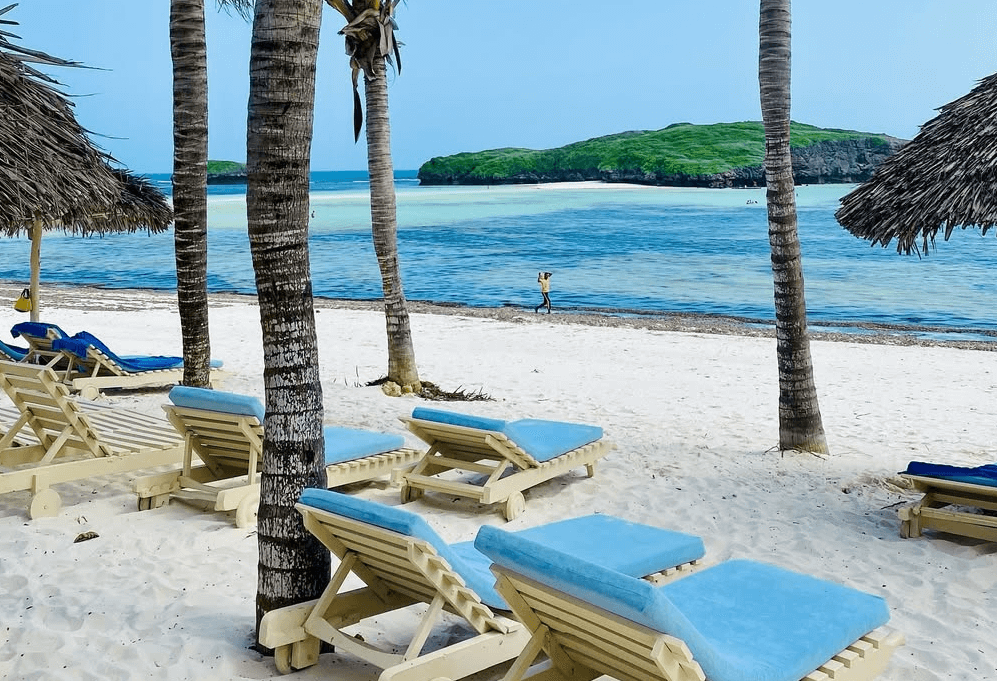
Watamu Marine National Park is a National park in Watamu, Kilifi County, Kenya. The park is renowned for its exceptional coral reefs, particularly the Coral Gardens.
Watamu offers sanctuary to diverse marine life, including green sea turtles, whale sharks, and over 600 species of fish. Watamu Marine National Park is a protected marine area located on the Kenyan coast, established to conserve its rich underwater ecosystem.
Overview
Name
Watamu Marine National Park
Type
Beach
Town
Watamu
County
Kilifi
Country
Kenya
Key Facts About Watamu Marine Park in Kilifi, Kenya
Attribute Category
Specific Detail
Location coordinates
Approximately 3°21'39.6"S, 40°01'04.8"E (-3.361, 40.018)
Governance/Management
Kenya Wildlife Service (KWS)
Total area
10 square kilometres (3.9 sq mi)
Entry fees
Fees vary for citizens, residents, and non-residents. Refer to the official KWS tariff guide for current rates.
Primary attraction
Coral Gardens, snorkelling, diving, glass-bottom boat tours, and observation of marine life such as turtles, dolphins, and diverse reef fish.
Best time to visit
January to March and July to October, coinciding with dry seasons when the sea is calmest and visibility is excellent for underwater activities.
Watamu Marine Life and Biodiversity
The ecological significance of Watamu Marine National Park stems from its designation as part of a UNESCO Biosphere Reserve.
Watamu protects a complex transition zone comprising mangroves, seagrass beds, and coral gardens, distinguishing itself from offshore reserves with a purely pelagic focus. This interconnectivity supports over 600 fish species and offers important nursery grounds for oceanic predators.
Coral Reef Ecosystem
The park features a fringing reef located approximately 1 kilometre offshore, distinct from the barrier reefs found further south in the Zanzibar Archipelago. The reef structure is dominated by hard coral genera, important for breaking wave energy and sustaining the lagoon environment. Biological surveys indicate high concentrations of:
Porites cylindrica (Finger Coral): Forms massive colonies that serve as shelter for juvenile fish.
Acropora (Staghorn Coral): Found on the reef crest, though subject to recovery monitoring following historic bleaching events.
Galaxea fascicularis (Octopus Coral): Often sighted in deeper reef slopes.
Millepora (Fire Coral): Prevalent in high-current areas near the channel openings.
Fish Species Available at Watamu Park
The inner lagoon and outer reef slopes offer distinct ichthyological zones. The seagrass beds are inhabited by herbivores, while the outer slopes attract larger carnivores. Visitors conducting species counts or photographic sampling will frequently encounter:
Parrotfish (Scaridae): Key bio-eroders responsible for sand production.
Surgeonfish (Acanthuridae): Specifically the Powder Blue Surgeonfish.
Moorish Idol (Zanclus cornutus): Often confused with Bannerfish, found in pairs.
Sweetlips (Haemulidae): Oriental Sweetlips are common near overhangs.
Napoleon Wrasse (Cheilinus undulatus): An endangered species occasionally sighted on the outer drop-offs.
Marine Mammals and Turtles
Watamu is distinct from competitors like Malindi Marine Park due to its well-developed sea turtle rehabilitation infrastructure. The area is an important nesting site for endangered Cheloniidae. The Local Ocean Conservation organisation operates closely with the park to monitor clutches and rehabilitate injured specimens.
Cetacean sightings follow seasonal migration patterns, offering observation opportunities generally unavailable in the shallow inner lagoons of the south coast.
Green Turtle (Chelonia mydas): The most common species, frequently grazing on seagrass in the lagoon.
Hawksbill Turtle (Eretmochelys imbricata): Often spotted feeding on sponges in the coral gardens.
Humpback Whales (Megaptera novaeangliae): Visible from the shore or outer reef boats during the migration corridor peak between July and September.
Indo-Pacific Bottlenose Dolphin: Resident pods inhabit the deeper channels beyond the reef.
Things to Do at Watamu Marine Park
The user experience in Watamu prioritises low-impact interaction with the marine environment. Watamu focuses on wind-propelled and passive observation activities, distinguishing itself from the high-traffic motorised sports common in Mombasa.
Snorkelling and Diving
The park creates a protected lagoon suitable for novice snorkellers, while the outer reef caters to advanced SCUBA divers. The absence of heavy siltation, characteristic of areas near major river mouths (like the Sabaki River further north), ensures superior visibility often exceeding 20 metres.
Moray Reef: Known for a significant overhang and resident Giant Moray Eels.
The Canyon: A deep channel featuring large trevally and occasional reef sharks.
Brain Coral Garden: A shallow site inside the lagoon, accessible during low tide for snorkellers.
Drift Diving: The currents through the channels allow for drift dives, moving divers past dense concentrations of soft corals.
Boat Tours and Excursions
Local operators utilise specific vessel types mandated by park regulations to minimise reef damage. The primary mode of exploration involves glass-bottom boats, which allow for non-intrusive observation.
For a culturally distinct experience, traditional Dhow sailing trips access Mida Creek, a tidal inlet lined with mangroves that borders the marine park.
Stand Up Paddleboarding (SUP) has gained traction as a method to explore Dolphin habitats without engine noise, reducing acoustic disturbance to the mammals.
Bird Watching at Watamu Marine
The interface between the marine park and Mida Creek creates a diverse avian habitat. The marine park focuses on aquatic life, yet the exposed sandbars at low tide serve as important feeding grounds for migratory waders. This ornithological overlap distinguishes it from the isolated marine environments of Diani.
Crab-plover (Dromas ardeola): Watamu is a primary wintering ground for this species.
Greater Flamingo: Flocks often frequent the saline shallow waters of the creek mouth.
Dimorphic Egret: Resident populations inhabit the mangrove fringes.
Terns: Roseate and Sooty Terns utilise Whale Island for breeding during specific seasons.
Cultural Significance and Local Communities of Watamu
The marine park does not exist in a vacuum; it is integrated with the Bajuni and Giriama communities. The management strategy involves these communities to mitigate poaching and encourage sustainable resource use.
Traditional Fishing Practices
Fishing is prohibited within the core protected area; however, the immediately adjacent reserves allow for traditional artisanal fishing.
Visitors can observe the use of ngalawa (outrigger canoes) and basket traps. This contrasts with industrial trawling, highlighting a subsistence economy that has coexisted with the reef for centuries.
Sustainable Tourism Practices
Watamu distinguishes itself through community-led conservation groups. The Watamu Marine Association (WMA) coordinates waste management and recycling initiatives that directly employ local residents to keep the beaches plastic-free.
This creates a circular economy where tourism revenue funds environmental maintenance, a model less prevalent in unregulated coastal strips.
Watamu Marine National Park Entry Fees and Costs
Entrance fees for Watamu Marine National Park are managed by the Kenya Wildlife Service (KWS) and contribute to the conservation of this delicate marine ecosystem.
The pricing is structured based on visitor status and is typically valid for a 24-hour period. It is important to confirm the latest rates on the official KWS website before your visit, as these are subject to change.
KWS Park Fee Structure
The standard fee structure differentiates between three main categories:
East African Citizens: Applicable to citizens of Kenya, Uganda, Tanzania, Rwanda, Burundi, and South Sudan. Proof of national identity (ID card or passport) is required.
East African Residents: Applies to non-citizens residing in East Africa with valid work permits or residency documents. Proof of residency is required.
Non-Residents: This category is for all international visitors and tourists who do not fall into the above two categories.
Additionally, fees are broken down by age:
Adult: Standard rate for individuals aged 12 and above.
Child: A reduced rate for children aged 3 to 11. Infants are typically free of charge.
Payments at the park gate are often made via cashless methods such as M-Pesa or credit/debit card. Visitors should always carry their identification.
Additional Potential Costs
Boat Fees: The park entrance fee does not usually include the cost of hiring a boat for snorkelling or diving trips. This is negotiated separately with local boat operators.
Marine Guide: Hiring a certified guide is highly recommended for the best and safest experience. This is an additional cost.
Equipment Hire: Snorkelling masks, fins, and life jackets can be hired from boat operators or local dive shops for a small fee.
Getting to Watamu - Transport and Logistics
Watamu is located on the Kenyan coast, approximately 120km north of Mombasa and 20km south of Malindi. Your primary point of origin will likely be Nairobi.
By Air (The Fastest Route)
Flying is the most efficient way to reach the coast from Nairobi.
Nearest Airport: Malindi Airport (MYD) is the closest and most convenient airport to Watamu, situated just a 30-minute drive away.
Airlines: Several reputable airlines operate daily flights from Nairobi's Wilson Airport (WIL) or Jomo Kenyatta International Airport (NBO) to Malindi. Key operators include Safarilink, Jambojet, and Kenya Airways.
Journey Time: The flight itself is approximately 1 hour. From Malindi Airport, you can easily hire a taxi or a pre-arranged hotel transfer to take you directly to your accommodation in Watamu.
By Road (The Scenic Route)
Driving from Nairobi offers a chance to see the Kenyan landscape but requires significant time.
Route: The journey follows the main A109 Highway (Nairobi-Mombasa Road) before turning off onto the Malindi-Mombasa road.
Distance & Time: The drive is approximately 600km and can take anywhere from 10 to 14 hours, depending heavily on traffic leaving Nairobi and road conditions. It is advisable to break the journey overnight in a town like Voi or Mtito Andei.
Public Transport: Several long-distance bus companies (e.g., Modern Coast, Dreamline) operate comfortable overnight services from Nairobi to Malindi or Mombasa, from where you can take a connecting taxi or matatu to Watamu.
By Rail and Road (The Modern Option)
The SGR (Standard Gauge Railway) Train offers a comfortable and reliable alternative to the full road journey.
Route: Take the Madaraka Express train from the Nairobi Terminus to the Miritini Terminus in Mombasa. The journey is scenic and takes approximately 5-6 hours.
Connection: From the Miritini SGR Terminus, you will need to arrange onward road transport to Watamu. This is a 2.5 to 3-hour drive by taxi, ride-hailing service, or a pre-booked shuttle. While comfortable, this option requires planning for the final leg of the journey.
Where to Stay and Accommodation Strategy for Watamu
Watamu offers a diverse range of accommodation options to suit different budgets and travel styles. There are no lodges directly inside the marine park itself; all accommodation is located along the coastline, providing excellent access to the park's entry points.
1. Beachfront Resorts & Boutique Hotels
These are concentrated along the main stretches of Watamu Beach and Turtle Bay, offering direct access to the sand and sea.
Best For: Families, couples, and travellers seeking convenience, all-inclusive packages, and amenities like swimming pools, restaurants, and water sports centres.
Location Logic: You are in the heart of the action, within walking distance of the marine park entrance, local restaurants, and shops. The trade-off can be less seclusion during peak season.
2. Mida Creek & Eco-Lodges
Situated on the serene, mangrove-lined shores of Mida Creek, these properties offer a tranquil escape focused on nature.
Best For: Birdwatchers, nature lovers, and those seeking a peaceful, eco-conscious retreat away from the main beach crowds.
Location Logic: Offers a unique perspective of the Watamu ecosystem. Access to the main marine park requires a short boda-boda (motorcycle taxi) or tuk-tuk ride, yet it provides excellent access to the creek for kayaking, stand-up paddleboarding, and stunning sunset views.
3. Private Villas & Self-Catering Guesthouses
Scattered throughout Watamu, often set slightly back from the main beach, are numerous private villas, apartments, and guesthouses available for rent.
Best For: Larger groups, families wanting more space and flexibility, and long-stay visitors on a budget.
Location Logic: Provides privacy and a "home away from home" experience. You have the freedom to cook for yourself and live like a local. Proximity to the beach and park varies, so confirm the exact location and transport options before booking.
For an optimal experience encompassing beach activities, snorkeling, and diving in Watamu Marine National Park, the primary dry season from January to March is highly recommended. This period offers abundant sunshine, minimal rainfall, and exceptional ocean clarity and calmness, ideal for marine exploration.